
Palestine Action groups spread worldwide despite UK ban
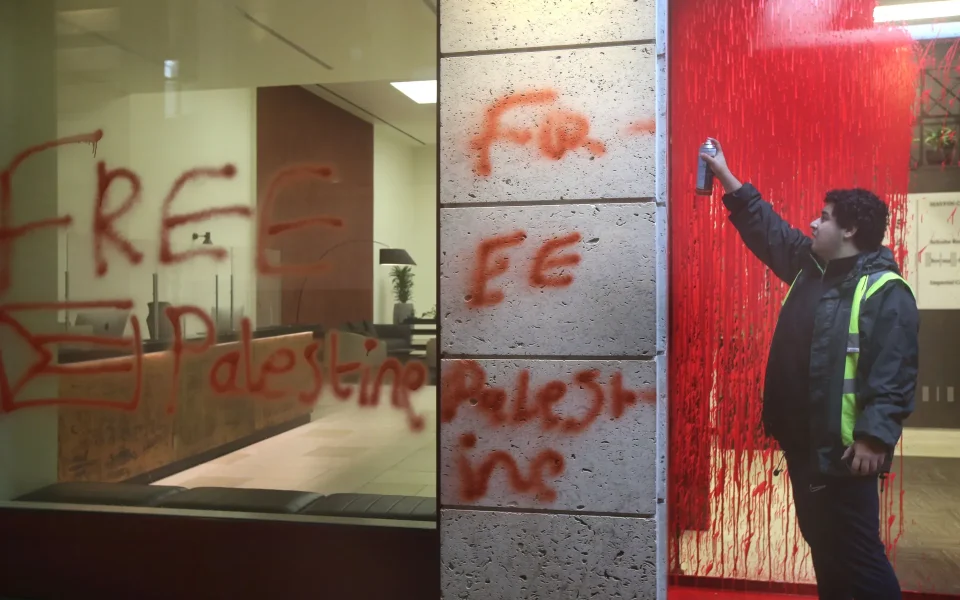
The banned UK organisation known as Palestine Action has inspired a wave of like‑named collectives that are now operating in several European countries and Canada, according to activists and observers. In November 2023, protesters sprayed the Rome headquarters of Leonardo, an Italian weapons manufacturer with contracts supplying Israel, echoing a prior demonstration at Leonardo’s Edinburgh plant that forced that factory to shut temporarily. Luca, who represents the Italian offshoot called Palestine Action Italy, told reporters the action in Italy was the first step in a broader movement.
Palestine Action Italy, which began as a modest echo of its British predecessor, now boasts tens of thousands of followers on social media and has organised multiple occupations of Leonardo facilities. The group works closely with other Europe‑based Palestine Action chapters to run training sessions on direct‑action tactics, teaching participants how to seize and disrupt weapons‑production sites. “Palestine Action is the closest way to be against the war. They are creating weapons, we are destroying them,” Luca said.
The ripple effect extends beyond Italy. In the Netherlands, Ireland, Spain, France and Canada, activists have adopted the same name and similar methods, targeting companies they allege support Israel’s military operations. In Canada, a subsidiary of Elbit Systems, Israel’s largest arms maker, was raided and spray‑painted by a squad identifying themselves as Palestine Action Canada. Earlier in the year, a group of occupiers forced the evacuation of a Montreal Scotiabank branch after it was revealed the bank held investments in Elbit; the bank later divested from the firm.
France saw more than twenty protesters block entry to Safran Data Systems in Les Ulis, halting work for almost three hours. The company, part of Safran Electronics and Defence, supplies fighter‑jet components to Israel and collaborates with Rafael on sensor technology that dramatically shortens kill‑chain times. A spokesperson for the anonymous group Stop Arming Israel France, which helped organise the blockade, said the actions were intended to “disrupt the business‑as‑usual activities of the ‘merchants of death’.” The spokesperson added that Palestine Action’s tactics serve as a source of inspiration for French activists.
In the Czech Republic and Germany, similar direct‑action protests have been reported, with groups accusing Israeli‑linked factories of complicity in what they describe as genocide in Gaza. Huda Ammori, co‑founder of the original UK Palestine Action, told Al Jazeera that the movement is expanding because Israel’s weapons industry depends on a global supply chain. “Those sites are pressure points which ordinary people can disrupt to bring down the Israeli war machine,” she explained.
Italy’s maritime front has also felt the influence of the movement. The Global Sumud Flotilla Italia (GSF Italy) used three small vessels to intercept the container ship Sundaid X, which was carrying military cargo destined for the nearby Sigonella naval air base, a key logistics hub for U.S. operations in West Asia. Police detained the activists, accusing them of disturbing public order, while GSF Italia spokesperson M credited the tactics of climate‑justice groups and Palestine Action for shaping their approach. “We are disturbing them,” M said, referring to the arrests as evidence that the campaign is having an impact.
The UK government’s decision to proscribe Palestine Action as a terrorist organisation in July 2025 has not dampened the overseas offshoots. Since the ban, roughly 4,000 people have faced arrests linked to the group, including peaceful demonstrators carrying signs that read “I oppose genocide. I support Palestine Action.” The banned group is scheduled to appear in court again on Wednesday to contest the prohibition. Luca warned that the recent U.S. sanctions against Palestine Action, which cut off the Italian chapter’s access to a donation platform, signal a new level of pressure. “We are getting ready to face this level of sacrifice: when we have to switch from being considered activists to being considered terrorists,” he said.
As the network of Palestine Action‑named groups continues to coordinate training, occupy facilities and stage high‑visibility actions across continents, observers note that the movement’s resilience show the challenge authorities face in curbing transnational protest campaigns. The next phase will likely involve further legal battles in the UK and heightened scrutiny of overseas chapters as governments weigh security concerns against the right to protest.










Join the conversation