
French student protests meet Macron officials, demand real change
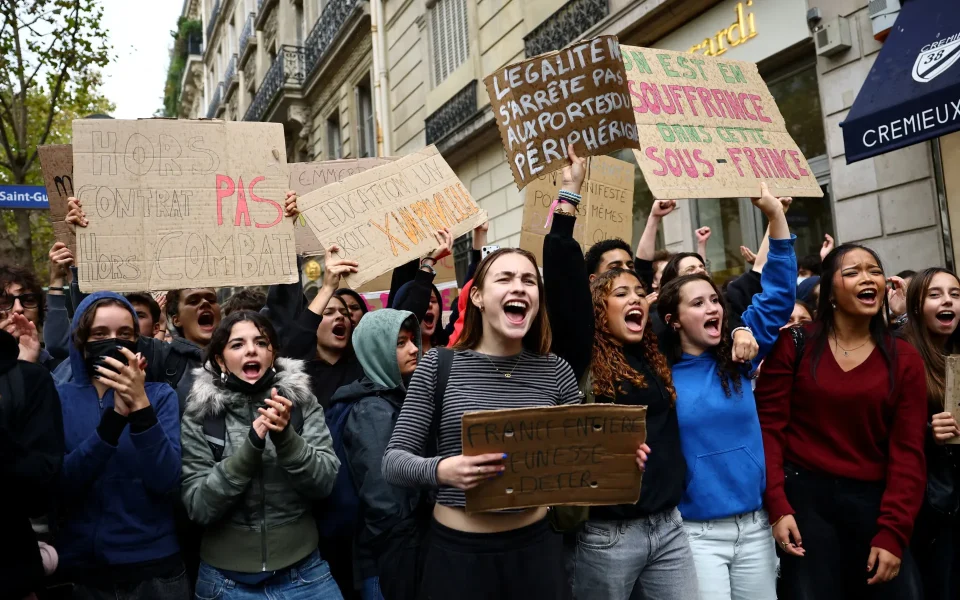
The wave of French student protests has reached the corridors of power, with high‑school representatives sitting down with President Emmanuel Macron, Prime Minister Sébastien Lecornu and Education Minister Édouard Geffray in Paris. The meetings, some lasting up to two hours, were described by 17‑year‑old activist Marius Mensil as courteous but empty‑handed, with officials smiling, taking notes and then walking away without concrete commitments. Mensil, a co‑leader of the Union Syndicale Lycéenne (USL), told Al Jazeera that the government’s “listening” is “just a way to avoid making any concrete commitments”.
The dialogue began after the movement, which started in Mayotte’s high schools, spread to the mainland on 17 September when a Creil‑area school in Créteil sparked blockades and street actions. Since then, tens of thousands of students across the Paris suburbs and beyond have repeatedly shut school gates, demanding a complete overhaul of the education system. Their grievances include chronic teacher shortages, dilapidated school buildings and a university admissions platform, Parcoursup, they say is opaque and biased against disadvantaged pupils.

In the sessions with Geffray, Mensil recounted a “technical” exchange in which the minister tried to explain why the students’ proposals were not feasible. He added that while Macron and Lecornu appeared attentive, “they did everything they could to show us that our demands were being heard”. The feeling of being heard without being acted upon was echoed by Bilal Narjissi, a 17‑year‑old from Saint‑Denis who also attended meetings. Narjissi described the talks as “very relaxed” and “open to dialogue”, yet warned that ministries remained “quite firm” on issues such as baccalaureate reform, leaving many of the students’ expectations unaddressed.
Key demands from the protestors remain stark. They call for a total reconstruction of Parcoursup, arguing that its reliance on the academic reputation of a high school marginalises talented learners from poorer districts. They also seek an emergency renovation plan for failing school infrastructure, more teachers on permanent contracts, and an additional €10 billion earmarked for education. In response, the government has announced a recruitment drive of 920 substitute teachers in early October, with plans for 3 000 more, and a pledge to increase the budget for substitute hours next year.
The Ministry of Education issued a statement on 26 October, citing measures that include capping class sizes at 28 pupils in the most disadvantaged schools from the 2027 academic year and reducing specialised course sizes. It also promised to update Parcoursup to give students “greater peace of mind” when planning their academic paths. While some activists view these steps as “a few crumbs”, Mensil acknowledges that the concessions demonstrate that the movement is beginning to make an impact. “The government is starting to give in,” he said, noting that “Gen Z, together with the workers, have forced Macron to back down on some initial points”.
Beyond the high‑level meetings, the administration launched a consultation platform titled “High school students, the floor is yours”. Over an 18‑day period beginning 6 October, more than 100 000 submissions poured in, with roughly 70 percent of respondents describing the current system as ill‑suited to their needs. Respondents highlighted overly long school days, often stretching from 8 a.m. to 6 p.m., heavy homework loads and insufficient breaks. Over half of the participants, 56.3 percent, complained about dilapidated buildings, poor insulation and inadequate equipment. The data also revealed persistent problems in disadvantaged suburbs, where roofs have collapsed, water leaks persist and classrooms regularly house 30 students.
Experts note that the roots of the unrest trace back to reforms introduced in 2018 by former Education Minister Jean‑Michel Blanquer, which increased subject concentration, shortened the baccalaureate and placed greater emphasis on grades. According to Rafaela Uzan of the Council on Foreign Relations, these changes have intensified social stratification and lengthened school days, fueling the current discontent.
The protest movement remains resolute. Narjissi, who has asked a special adviser to the prime minister to visit his school in Saint‑Denis, warned that without tangible outcomes, the dialogue risks becoming a “talk‑only” exercise. “We’ve managed to establish a balance of power through our mobilisation,” he said, signalling that the students will continue to press for change. Student representatives are slated to meet the prime minister again on Monday, hoping that forthcoming announcements will align with their expectations. If the meetings fail to produce concrete policy shifts, the protests are set to persist, keeping the spotlight on the state of French education.











Join the conversation