
Drone attacks Libya and Finland spark fears of war spillover
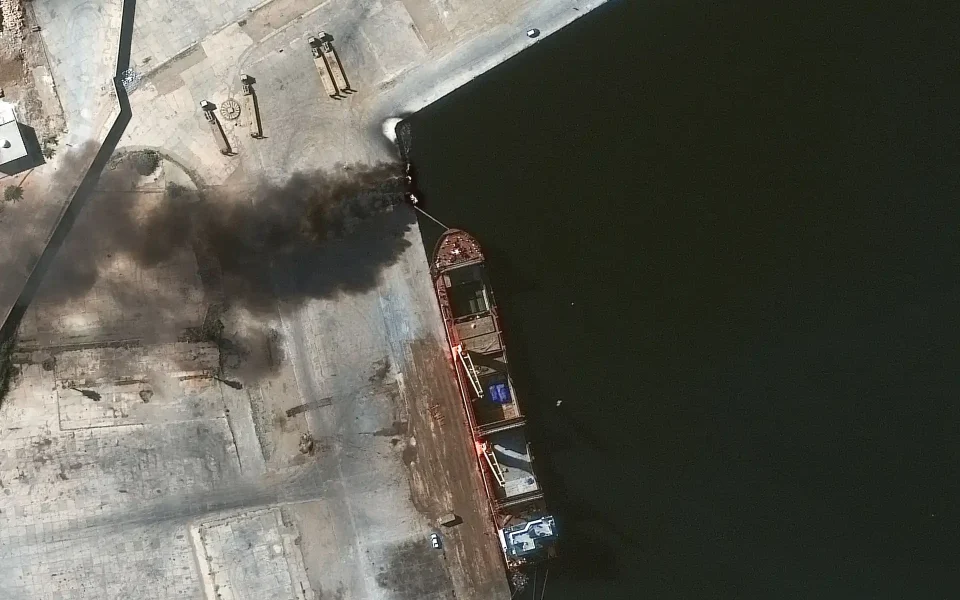
The Ukrainian president announced on Monday that seven Ukrainian‑made naval drones were deployed in a series of strikes that hit Russian targets off the coast of Libya and in the Gulf of Finland, a development that analysts say could signal the war’s geographic expansion. President Volodymyr Zelenskyy posted on X that the attacks sank the Russian corvette Merkury and struck the cargo vessel MV Angara, which he described as a weapons transporter, while a separate drone strike earlier in the week damaged the Russian cargo ship Sparta II in Finnish waters.
According to satellite images, the Merkury was hit while moored at the Benghazi naval base in eastern Libya on Sunday, igniting a fire that caused the corvette to capsize and sink, leaving only its bow above water. Zelenskyy confirmed the loss and added that a Russian Kamov Ka‑27 helicopter was also destroyed in the same engagement. The second target, the MV Angara, was reportedly hit as well, though the vessel remained afloat after the strike. In Finland, the Sparta II caught fire after being struck by two drones in international waters, prompting the evacuation of all 16 crew members, one of whom suffered a minor injury. Finnish military officials said the attack was likely carried out by Ukraine, though Kyiv has not formally claimed responsibility for the Finnish incident.

Libyan authorities in the east condemned the strikes, calling them violations of national sovereignty and demanding a United Nations‑led investigation. A statement from the eastern administration warned that Libya would not allow its ports or waters to become a venue for external powers to settle scores. Meanwhile, the rival government in Tripoli echoed concerns, highlighting the risk of civilian ports being drawn into foreign conflicts. The United Nations Support Mission in Libya (UNSMIL) posted a statement on X expressing “serious concern” and urging an “immediate, independent and transparent investigation” into the drone attacks. Both Libyan factions stressed that the country could not afford to become a battleground for outside wars.
The attacks fit within a broader Ukrainian campaign aimed at Russian naval assets, energy infrastructure, and vessels linked to Moscow’s “shadow fleet,” a network used to evade Western sanctions. Over the past month, at least four Russian ships have been reported struck, including the Merkury, MV Angara, Sparta II, and a Russian warship detected in the Gulf of Finland. Earlier incidents this year saw a Russian LNG tanker sink off Libya after a similar strike that Moscow blamed on Ukraine, and in December 2025 Kyiv claimed responsibility for hitting a Russian‑linked oil tanker in the Mediterranean. These actions show a pattern of targeting Russian maritime logistics beyond the Black Sea.
Experts say the Mediterranean has become an external theatre of operations for the conflict. Alexey D. Muraviev, a senior research fellow at Edith Cowan University, noted that vessels operating in Libyan and Finnish waters are likely involved in moving military equipment to support Russia’s activities in Africa, including the so‑called Africa Corps. He added that the sinking of the Merkury, a ship commissioned only in 2023, weakens Russia’s naval presence in the region. Muraviev warned that the Gulf of Finland remains a particularly sensitive zone because of its proximity to both Russian and NATO forces, raising the possibility of a direct clash between the two sides. He also pointed out that the attacks add to the growing security challenges facing global shipping lanes already strained by tensions near the Strait of Hormuz and Bab al‑Mandeb.
Reactions from the Russian side have been muted in public statements, but Moscow has described the series of strikes as part of a “new Iron Curtain” erected by neighboring states, referencing Estonia’s recent border closures. Diplomatic notes from Russia to several European capitals have urged restraint, arguing that extending the conflict to neutral waters threatens regional stability. In contrast, Ukrainian officials maintain that their operations are a legitimate response to Russian aggression, with Zelenskyy pledging to continue attacks in designated maritime zones until Russia ceases its bombardments of Ukrainian territory.
The next steps appear to involve diplomatic and investigative channels. The United Nations is expected to convene a panel to examine the legality of the drone strikes and assess potential violations of international law. Meanwhile, both Libyan administrations have called for heightened security around their ports to prevent further incursions. In Finland, military authorities are reviewing the incident to determine whether additional defensive measures are needed along the Gulf’s coastline. As the situation evolves, analysts will watch closely for any escalation that could draw NATO members or other regional actors into direct confrontation, a scenario that would further broaden the scope of a war that began five years ago.















Join the conversation