
French school protests persist as students claim “no change”
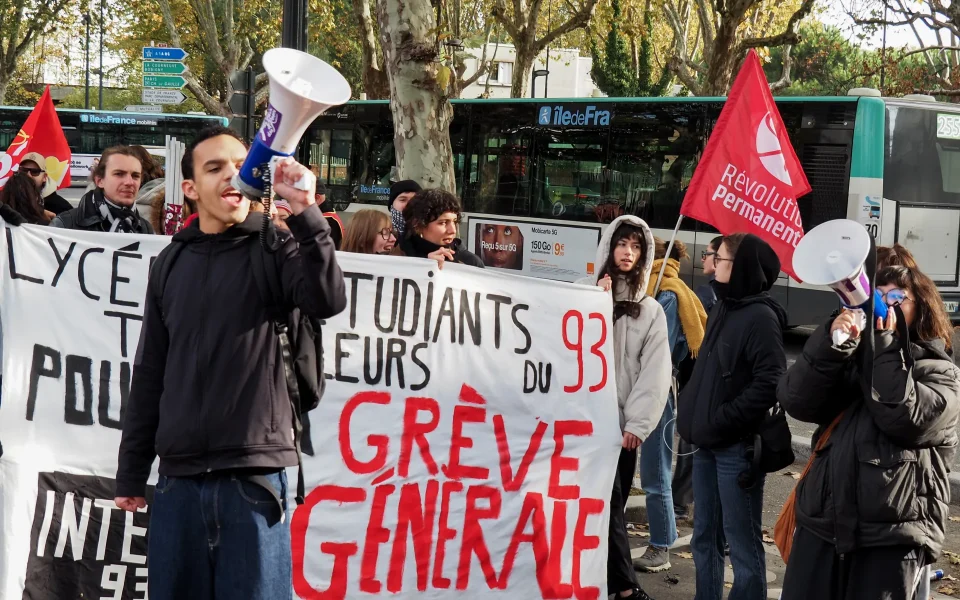
On a rainy November morning in Saint‑Denis, the gates of Paul Eluard high school were locked while students and teachers gathered outside, demanding better conditions in their classrooms. Among them, 17‑year‑old Kamelia, dressed in a dinosaur costume, said the protest was “not all about violence” and that “everyone is rising up, all the young people.” The same day, pupils at the nearby Bartholdi trade school blocked their entrance, echoing complaints about filthy restrooms, slow‑flowing water and cockroach infestations. Their grievances mark the latest chapter of a movement that began in Creteil on 17 September and has since spread across the country.
The protests, which initially erupted in the suburbs of Paris, have grown to involve an estimated 400 schools, including several universities. Interior Minister estimates placed the October 17 march in Paris at 550,000 participants, while organisers claimed up to 800,000 turned out. Though the peak of street demonstrations occurred in early October, many students in the outer districts refuse to return to class until concrete improvements are made. The blockades at Paul Eluard and Bartholdi illustrate how the movement has shifted from occasional sit‑ins to sustained occupations of school premises.

Students describe daily life in their schools as untenable. Nohlan, a 17‑year‑old pupil at Bartholdi, told reporters that “sometimes, we see rats in the courtyard and in the restrooms. The restrooms are a mess. We don’t have enough water; it flows very slowly. We don’t have enough to drink, and the restrooms are dirty. The hallways are dirty, the classrooms are dirty, and there are cockroaches.” Such accounts are echoed by teachers who have joined the strike in solidarity. Lucie Sabze, an English teacher at Paul Eluard, said she is “impressed by the students, their demands and their political discourse, which is very lucid and very clear,” adding that the scale of the movement reflects a “growing frustration” among educators and learners alike.
The dispute has also exposed tensions within school administration. At Paul Eluard, teachers had long called for the resignation of the headmaster after an incident involving a member of the national antiterrorism brigade who entered the school to arrest a student. On Sunday, the Academic Director of National Education Services announced that Xavier Artaud had stepped down “as a safety precaution,” noting that the principal had requested protective measures following “unacceptable public accusations.” The removal of Artaud has been hailed by staff as a small victory amid broader grievances.
National politics have entered the fray as well. President Emmanuel Macron, in an early‑October statement, pledged to respond to the students’ demands “in the most concrete way possible,” acknowledging “the anxieties, sometimes the anger, that our youth can have.” Yet many protestors remain skeptical. Nohlan summed up the sentiment, saying, “There’s still no change. We’re hoping for change, but we’re waiting, and waiting.” Critics of the government, such as Louis Boyard, a deputy from Val‑de‑Marne, argue that Macron’s austerity policies have “gradually dismantled public education while providing massive subsidies to the private sector.” Boyard warned that “one in three French people are skipping meals” and that young people “have gone too far in this movement to back down now.”
The left‑wing France Unbowed (LFI) party, led by Jean‑Luc Mélenchon, has been accused of exploiting the protests for electoral advantage, given the party’s polling around 20 percent ahead of the upcoming presidential election. Boyard, however, insists the movement is organic, noting that LFI simply “always [is] on the side of those who fight.” He recalled his own participation in a 2018 blockade over asbestos at his former school, which resulted in the building’s reconstruction, and affirmed that “the current students… are justified in doing it.”
Teachers on the ground also note a long‑term decline in resources. Bruno Gbalou, an English teacher at Bartholdi who returned from England fifteen years ago, observed that “there are more students, but we have fewer resources.” He argued that this imbalance “is not fair to the students, and it’s not fair to us, and that’s one of the reasons why we’re going on strike.” The shortage of staff and supplies, combined with aging infrastructure, has turned many schools into flashpoints for broader discontent about public service funding.
While the protests have sometimes taken on theatrical elements, costumes, banners and chants, the underlying demands remain focused on tangible upgrades: clean restrooms, reliable water supply, adequate heating, and a safe learning environment. Kamelia, who chose a dinosaur suit to keep “joy and hope” alive amid anger, said the costumes “show that it’s not all about violence. There’s also good cheer and fun in all of this.” Her remarks underline the desire among many participants to keep the movement inclusive and non‑violent, even as frustrations run high.
As the November blockades continue, authorities have yet to present a detailed plan addressing the specific grievances raised at Paul Eluard, Bartholdi and other schools. The Academic Director’s statement about the principal’s removal suggests a willingness to act on safety concerns, but broader reforms remain pending. With the presidential election looming and public attention fixed on the suburbs, the government faces pressure to translate promises into concrete improvements before the next school term begins. The next steps of the French school protests will likely hinge on whether officials can deliver on the demands that have kept students and teachers occupying school gates for weeks.














Join the conversation