
Cocaine Airport Seizure Leads to Arrest of Two Businessmen at Abuja Terminal
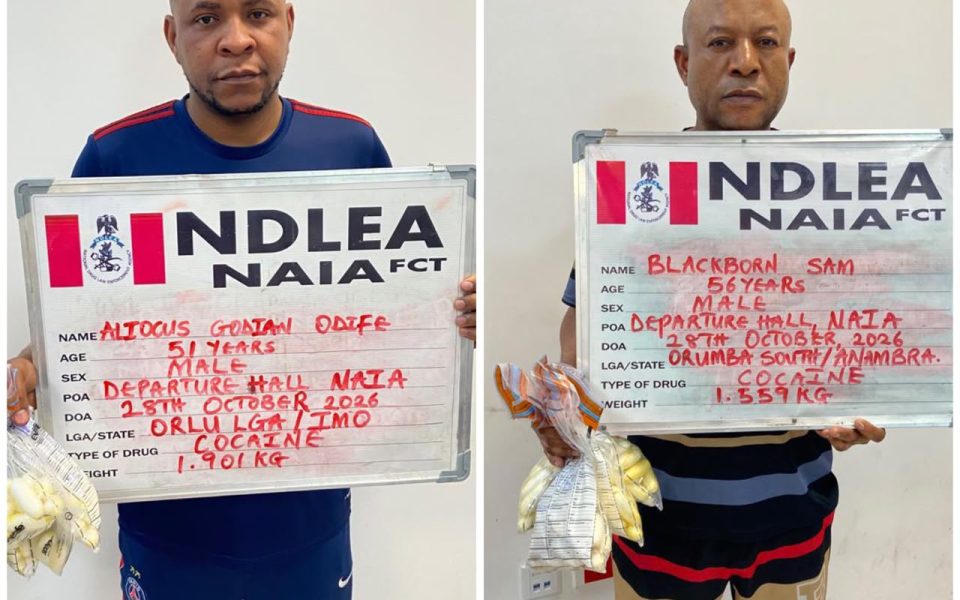
Two men were detained in a cocaine airport seizure at Nnamdi Azikiwe International Airport on Wednesday, 28 October 2026, after security scans revealed foreign objects in their stomachs. The pair, identified as Aliocus Godian Odife and Sam Blackborn, were about to board Air France flight AF 832 bound for Paris when NDLEA operatives intercepted them. Both men later expelled a total of 200 wraps of the Class A substance, weighing roughly 3.46 kilograms, before being taken into custody.
Odife, who says he lives in France and works in a factory there, arrived in Nigeria on 21 October for a brief holiday. He returned to the airport on the same flight schedule, where a body scan flagged a potential anomaly. In an interview with investigators, Odife admitted swallowing 110 pellets of cocaine. He was placed under observation, during which he expelled all 110 wraps, later confirmed to contain 1.901 kilograms of the drug.
Blackborn, travelling alongside Odife, faced a similar fate. The scan at the departure hall also indicated ingestion, prompting officers to detain him. He confessed to having swallowed 90 pellets of cocaine. While under observation, Blackborn expelled each of the 90 wraps, which collectively weighed 1.559 kilograms and tested positive for the same Class A substance. Both men were escorted to NDLEA facilities for further processing.
The operation show the agency’s heightened vigilance at Nigeria’s main international gateway. NDLEA officials highlighted that body scans have become a routine part of security checks, especially on flights heading to Europe where drug trafficking routes are well known. The agency noted that the successful detection of the concealed cocaine was due to the combined use of advanced scanning equipment and trained personnel who can interpret the results quickly.
Nigeria’s National Drug Law Enforcement Agency, established in 1990, is tasked with curbing the flow of illicit substances across the country’s borders. In recent years the agency has invested in non‑invasive imaging technology that can spot anomalies such as metal objects, dense foreign matter, or, as in this case, compacted drug packages hidden in the gastrointestinal tract. Such equipment is now standard at both Nnamdi Azikiwe International Airport and Murtala Muhammed International Airport in Lagos, reflecting a broader government push to align local security practices with international norms.
Legal experts say the quantities involved far exceed personal‑use thresholds, suggesting intent to distribute. Nigerian drug law classifies possession of such amounts as a serious offence, typically carrying lengthy prison terms. The two suspects are expected to face charges under the Narcotic Drugs and Psychotropic Substances Act, with their cases likely to be heard in federal court. Their legal representation has yet to comment publicly on the proceedings.
The practice of hiding drugs in bodily cavities, commonly referred to as “body packing,” has become a growing concern for customs and law‑enforcement agencies worldwide. In Nigeria, the method is often chosen because it can bypass conventional luggage inspections. Health officials warn that ingesting large quantities of cocaine can cause perforation of the intestinal wall, leading to severe internal bleeding or fatal overdose. The medical risk is why NDLEA officers routinely place suspects under observation in a controlled environment, allowing them to expel the packages safely before any invasive procedure is considered.
This incident adds to a growing list of recent interceptions at the airport, where authorities have reported an uptick in attempts to smuggle narcotics concealed in bodily cavities. In the past twelve months, several similar seizures have been recorded on outbound flights to Europe, reflecting the enduring appeal of the continent’s lucrative markets for traffickers. The NDLEA’s ability to detect these attempts relies not only on technology but also on the experience of its officers, who have been trained to recognize subtle signs such as abnormal abdominal movement or changes in a traveler’s demeanor during the security process.
In the wake of the seizure, airport officials reiterated their commitment to maintaining strict security protocols. They emphasized cooperation with international partners, including French law‑enforcement bodies, to ensure that any trans‑national trafficking networks are dismantled. The NDLEA also announced plans to increase random screenings on outbound flights, aiming to deter future attempts to move drugs out of the country. Such collaborations often involve sharing intelligence on known trafficking syndicates, joint training exercises, and coordinated operations at points of entry and exit.
As the investigation continues, both Odife and Blackborn remain in NDLEA custody pending arraignment. Authorities have indicated that further forensic analysis will be conducted on the seized material to trace its origin. The next court appearance is scheduled for early next month, where the men will be formally charged and given an opportunity to enter a plea. The outcome of the case is expected to send a clear message to other would‑be traffickers about the risks of using body‑packing methods at Nigeria’s busiest airports.

Reporter at 03naija.com.











Join the conversation