
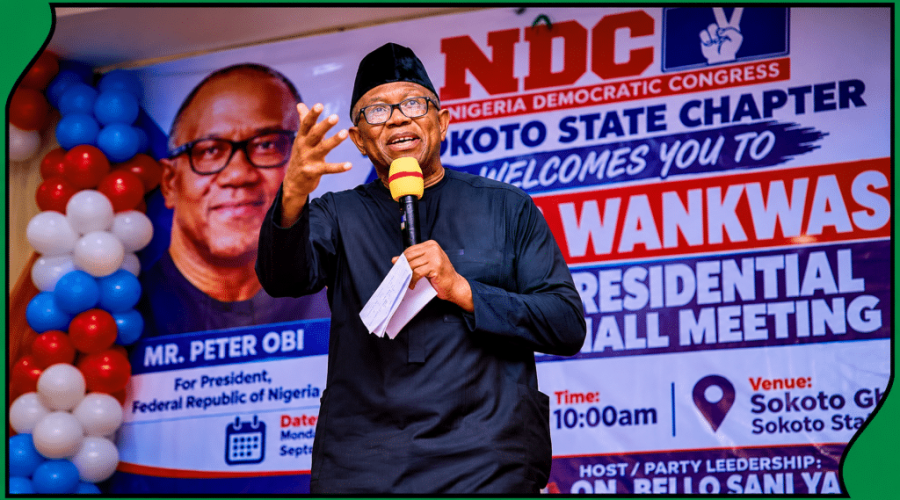
Peter Obi, the Nigeria Democratic Congress (NDC) presidential candidate, told the BBC on Tuesday that a future administration would bring back the petrol subsidy, provided it could be run without the corruption that has long haunted the programme. The statement marks a clear reversal from his 2023 campaign, when he argued for scrapping the subsidy altogether.
From day one to day one
Obi’s interview highlighted a central theme of his political narrative: “From day one, I’ve talked about subsidy. I talked about corruption; corruption is the problem of subsidy,” he said. He added that, if elected in the 2027 poll, his government would first purge the system of graft before reinstating the price support. “Yes. But remember, I have qualified it, not with the corruption that’s associated with it. I’ll remove the corruption and retain the subsidy,” he affirmed.
The former governor of Anambra State explained that the anti‑corruption drive would start at the top. He suggested that the conduct of the president and his immediate family would be a litmus test for the wider effort. “If you are not stealing, if you are not involved, your wife and family are not involved, you reduce it by 50 per cent,” Obi told the interviewer.
In Nigeria, the petrol subsidy has historically been managed by the Ministry of Finance and the Nigerian National Petroleum Corporation. Over the years, the scheme has been criticised for leakages, phantom deliveries and inflated invoices. Obi’s emphasis on cleaning the system reflects a broader public frustration with those patterns, which many Nigerians believe have cost the treasury billions while offering little relief at the pump.
Why the shift?
During the 2023 presidential race, Obi campaigned for the elimination of the petrol subsidy, arguing that the funds could be redirected to education, health care and infrastructure. President Bola Ahmed Tinubu subsequently ended the subsidy regime on the day of his inauguration, May 29, 2023.
Obi’s latest position follows a similar comment from his running mate, Dr Rabiu Musa Kwankwaso, who in September said an NDC government led by Obi would devise its own subsidy arrangement. The pair appear to be aligning on a message that the policy itself is not inherently flawed; rather, the way it has been administered is.
The shift can be read against the backdrop of a volatile global oil market, where Nigeria’s export earnings fluctuate with crude prices while domestic fuel costs have a direct impact on transport, agriculture and small‑scale enterprises. Many voters in the northern and central regions recall a time when the pump price was lower, even if the subsidy’s efficiency was questioned. By promising a “clean” version, Obi is trying to reconcile those memories with his long‑standing anti‑corruption stance.
Political implications
Obi also used the BBC platform to reject calls for him to step aside in favour of another opposition figure if a consensus ticket emerges for the 2027 election. “We don’t need to step down. We need to do the right thing,” he said, signalling his intent to remain the NDC flagbearer regardless of coalition talks.
His reversal on the subsidy issue may be an attempt to win back voters in the northern and central regions where fuel prices remain a daily concern. The subsidy has historically been a political flashpoint, with many Nigerians viewing it as a safety net against volatile global oil markets. By promising a clean, corruption‑free version, Obi hopes to tap into both the nostalgia for lower pump prices and the public’s demand for transparent governance.
Opposition parties are likely to test the feasibility of his promise. Restoring the subsidy without a clear funding roadmap could clash with the country’s fiscal constraints, especially as debt levels remain high. The ruling All Progressives Congress (APC) may seize on Obi’s change of heart to portray him as inconsistent, while also defending its own decision to end the scheme in 2023.
What lies ahead
The NDC has not yet released a detailed policy paper outlining how the subsidy would be financed or monitored under a future Obi administration. Critics point out that restoring the subsidy without a clear fiscal plan could strain the national budget, especially given the country’s ongoing debt challenges.
Nevertheless, Obi’s interview signals that the issue will feature prominently in his campaign trail over the next few years. As the 2027 election draws nearer, opposition parties are likely to test the viability of his anti‑corruption pledge, while the ruling All Progressives Congress (APC) may use the shift to question Obi’s consistency.
The next major step will be the NDC’s formal policy launch, expected later this year, where Obi is slated to present a comprehensive blueprint for the proposed petrol subsidy and the mechanisms intended to keep it free of graft. The rollout of that blueprint will determine whether the promise of a corruption‑free subsidy can move from rhetoric to practice.


Comments
No comments yet. Be the first to share your thoughts!