
More Kenyans Use Fuliza as Safaricom’s Overdraft Revenue Soars 86%
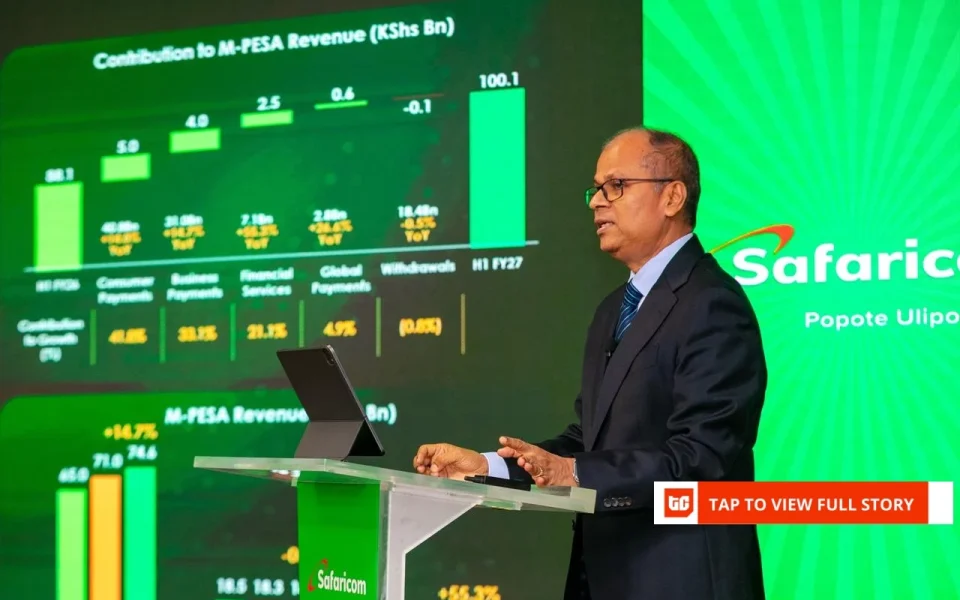
Safaricom, Kenya’s largest telecommunications operator, announced on Thursday that its Fuliza overdraft service generated KES 4.9 billion in revenue for the six months to September 2026. The jump of 86 percent over the same period a year earlier coincided with the number of borrowers almost doubling to 17.2 million, underscoring how quickly “fuliza revenue” has become a central pillar of the M‑PESA platform’s earnings.
The figures were revealed at an investor briefing in Nairobi, where senior executives described the performance of the service that lets M‑PESA users complete transactions despite insufficient wallet balances. Fuliza, which operates in partnership with NCBA Bank and Kenya Commercial Bank (KCB), disbursed KES 1.16 trillion during the half‑year, an 84 percent rise from the previous year. The surge in disbursements reflects a broader shift toward short‑term credit within the mobile‑money ecosystem, as more Kenyans turn to instant overdraft advances to bridge brief cash‑flow gaps.

While the user base expanded by 88.9 percent to reach 17.2 million, the average loan size fell sharply, dropping 24.6 percent to KES 192 (about $1.49) from KES 254.60 a year earlier. Smaller advances suggest that borrowers are primarily using Fuliza for everyday purchases or to cover temporary shortfalls rather than for larger, longer‑term financing. This pattern aligns with the service’s design, which offers credit at the point of sale, effectively turning a payment transaction into a micro‑loan that is repaid shortly thereafter.
Fuliza’s growth outpaced Safaricom’s other mobile‑lending products, which are run in collaboration with banks. KCB M‑PESA, a savings and loan offering with Kenya Commercial Bank, posted revenue of KES 500 million, up 11.9 percent, even though its active customer base slipped 7 percent to 4.2 million. M‑Shwari, the micro‑loan service with NCBA Bank, recorded a 7.7 percent rise in revenue to KES 1 billion, while its active users fell 5.8 percent to 7.4 million. Together, those products contributed a modest share of the overall credit earnings, whereas Fuliza alone accounted for roughly 71 percent of revenue from Safaricom’s six lending offerings.
Nevertheless, repayment patterns reveal potential concerns. Fuliza’s repayment‑to‑disbursement ratio slipped to 99.6 percent from 102.4 percent a year earlier, indicating that a slightly larger share of the loans remains outstanding at the end of the period. KCB M‑PESA’s ratio also fell, reaching 96.7 percent, while M‑Shwari’s decreased to 105.3 percent from 108 percent. Although the overall repayment rate remains high, the decline signals that borrowers may be stretching their ability to repay as the service reaches a broader audience. Safaricom did not disclose the non‑performing loan ratio for Fuliza, nor how credit risk is divided between the telecom firm and its banking partners.
The data do not clarify whether the rise in borrowers stems mainly from existing customers taking more frequent advances, new users joining the platform, or adjustments in credit limits. Analysts note that the combination of smaller loan sizes and a near‑full repayment rate suggests a cautious expansion, yet the lack of transparency on loan performance leaves some uncertainty about long‑term sustainability. The company’s focus on behavioural scoring aims to mitigate defaults, but the rapid increase in user numbers could test those models.
Industry observers point out that mobile overdraft services like Fuliza are reshaping Kenya’s financial landscape. By providing instant credit at the point of sale, the service blurs the line between traditional payments and lending, creating new revenue streams for telecom operators while offering convenience to consumers. For many Kenyans, especially those without access to formal bank credit, an overdraft facility tied to a mobile‑money wallet can be a lifeline for daily expenses, school fees or small business cash‑flow needs.
The growing reliance on such credit is also prompting intensified competition among banks and fintech firms eager to partner with Safaricom or develop rival products. The regulator’s stance on mobile credit will shape the future trajectory of services that blend telecommunications with banking functions. Kenya’s central bank has been monitoring the expansion of mobile‑money lending, emphasizing consumer protection and the need for transparent reporting of loan performance. How these regulatory frameworks evolve could affect the scale and pricing of overdraft services like Fuliza.
Safaricom’s next steps include further integrating credit, savings, insurance and merchant services into the M‑PESA platform, as outlined in the investor presentation. The company plans to continue leveraging its extensive user base while refining risk‑assessment techniques. Upcoming quarterly reports are expected to explain the evolution of Fuliza’s loan performance, non‑performing ratios, and the broader impact of mobile credit on Safaricom’s financial health. The firm’s ability to balance rapid revenue growth with prudent risk management will be closely watched by investors and regulators alike.














Join the conversation