
Police nab fake soldier, seize stolen car in Bauchi after victim’s complaint
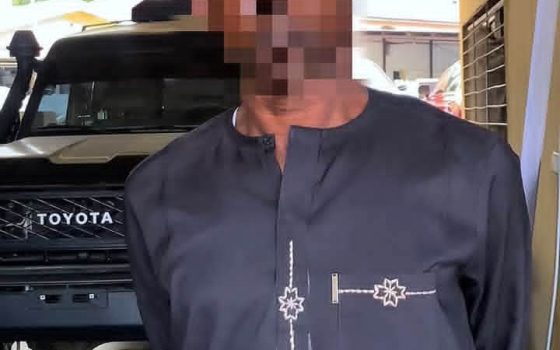
The Bauchi State Police Command announced on Friday that it had arrested a 26‑year‑old man accused of posing as a Nigerian Army soldier and of stealing a vehicle from a water factory owner in Bauchi. The suspect, identified as John Umar, was taken into custody after a resident of the Gida Dubu area lodged a formal complaint. The police said the arrest was part of an intelligence‑led operation that also resulted in the recovery of a white H‑Jet motor vehicle, a mobile phone and several army‑issue uniforms that the man allegedly used to masquerade as a soldier.
According to a statement released by the command’s Public Relations Officer, Nafiu Habib, the complaint came from a man known only as Salisu, who runs a pure‑water factory in the Bauchi metropolis. Salisu recounted that on 18 October 2026 he received a call from an unknown number. The caller introduced himself as John Umar Shehu and claimed to be seeking a driver’s position at the factory. The factory owner, believing the request, arranged an interview and a practical driving test for the following day, 19 October.
The meeting appeared routine until 22 October, when the alleged impersonator allegedly turned violent. During the assessment, the suspect is said to have attacked the factory owner and the son of a neighbour, then overpowered them and fled with the owner’s vehicle. The stolen car, described as a white H‑Jet bearing registration AE‑278‑ALK, and a green Infinix Smart 5X mobile phone were taken to an unknown location. The police report noted that the suspect also carried a range of military attire, suggesting he used the disguise to gain trust and facilitate the robbery.
Following the victim’s petition, detectives from the Bauchi command mobilised swiftly. Habib said the operation was guided by intelligence inputs that pinpointed the suspect’s movements. A subsequent search of Umar’s possessions uncovered a complete set of desert camouflage uniform with a jungle hat, a green camouflage uniform, an army raincoat, a camouflage vest and an army sweater. The items, according to police, were intended to bolster the fraudster’s claim of being a serving soldier.
Further investigation revealed that the suspect had presented himself as Private Umar Shehu, complete with a fabricated service number NA/22/82/1064. He claimed affiliation with the 7 Division, Maimalari Barracks, 134 Special Forces Battalion in Borno State. The police emphasised that the falsified identity was a deliberate ploy to exploit the public’s respect for the armed forces and to facilitate the theft.
The stolen vehicle was located in Jos, the capital of Plateau State, where Umar resided in the Bassa Local Government Area. Police retrieved the car from his possession, confirming that he had crossed state lines with the stolen asset. The recovery in Jos also linked the suspect to another jurisdiction, prompting cooperation between Bauchi and Plateau police units.
Commissioner of Police Sani‑Omolori Aliyu condemned the impersonation, stressing that the use of security agencies’ identities to commit crimes would not be tolerated. “The Command will not tolerate criminal impersonation of security agencies to perpetrate crime,” he was quoted as saying. Aliyu pledged that the suspect would face a thorough investigation and be charged in court, underscoring the police’s commitment to safeguarding the reputation of the nation’s security forces.
Impersonation of military personnel is not a new challenge for law enforcement in Nigeria. Over the years, fraudsters have adopted army or police uniforms to gain access to private property, solicit money or, as in this case, facilitate violent theft. The incident highlights the broader risk that such deceptions pose to ordinary citizens who may trust someone in uniform without verification. In many parts of the country, especially in commercial hubs, the sight of an individual in army attire can confer an automatic aura of authority, making it easier for criminals to manipulate victims.
The Bauchi police’s swift response was credited to the prompt filing of a petition by the water factory owner. The statement from the command noted that the complainant’s detailed account, combined with the suspect’s phone records and the recovered uniform items, enabled detectives to piece together the timeline and locate the stolen vehicle. The operation also demonstrates the growing reliance on intelligence‑led policing, where data and community reports drive investigative action.
Local residents expressed relief that the suspect was apprehended before he could repeat similar offences. Some voiced concerns about the ease with which the imposter obtained military gear, urging authorities to tighten control over surplus uniforms and equipment. While the police did not disclose how Umar obtained the uniforms, the recovered items suggest a network that supplies counterfeit or stolen military attire to individuals seeking to exploit the system.
The case also raises questions about the verification mechanisms employed by private employers when hiring staff who claim military backgrounds. In this instance, the factory owner arranged an interview based on a telephone call, without independently confirming the candidate’s service record. Experts advise that employers request official documentation or contact the relevant military office before granting positions that rely on the applicant’s alleged service.
As the investigation proceeds, the police have indicated that additional charges may be filed, including criminal breach of trust, assault, theft and impersonation of a security officer. The recovered vehicle is expected to be returned to its rightful owner pending the outcome of legal proceedings. The stolen mobile phone, a green Infinix Smart 5X, is also slated for forensic examination to determine if it was used to further the suspect’s illicit activities.
The incident arrives at a time when the Nigerian security apparatus is under scrutiny for internal fraud and external threats. The Bauchi State Police Command’s handling of the case may serve as a template for other commands dealing with similar impersonation schemes. By publicly naming the suspect, detailing the seized items and outlining the steps taken, the command aims to deter future fraudsters and reassure the public that the police are vigilant against misuse of uniformed identities.
The next phase will involve court proceedings, where the suspect is expected to face multiple counts. Authorities have not set a hearing date yet, but the commissioner assured that the case will be expedited to send a clear message that impersonation of the armed forces carries severe legal consequences. The recovered military uniforms are likely to be retained as evidence, and an internal audit may be launched to trace their origin.
In the meantime, the water factory owner hopes to resume normal operations without lingering fear of further attacks. The incident has prompted him and other local business owners to adopt stricter vetting procedures for prospective employees, especially those claiming security backgrounds. As the police continue to follow leads, the community watches closely, hopeful that the swift arrest will restore confidence in safety and deter any similar attempts to exploit the symbols of national security.

Reporter at 03naija.com.







Join the conversation