
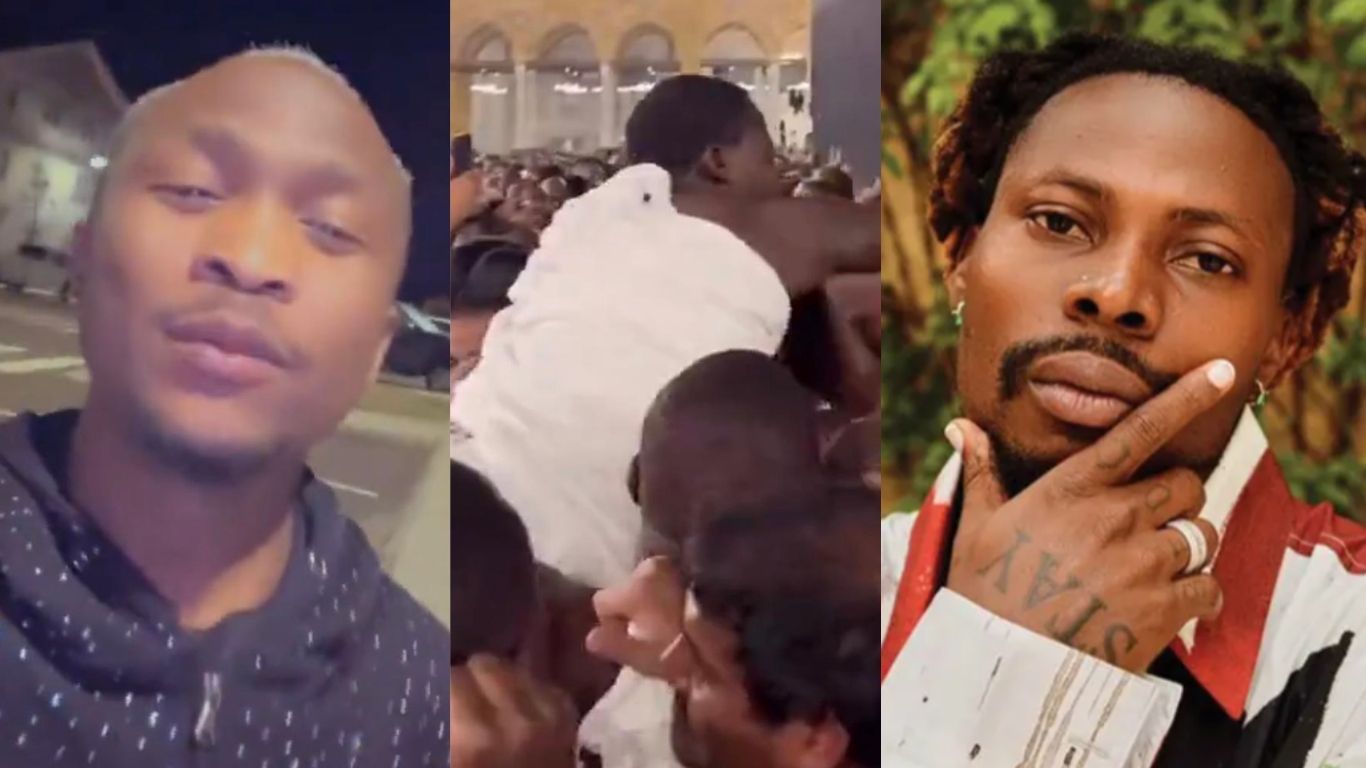
A video of Afrobeats star Asake appearing to touch or attempt to touch the Black Stone — the sacred stone embedded in the Kaaba at the Masjid al-Haram in Mecca — has gone viral across Nigerian social media, and in its wake, a man has sparked a fresh and highly charged debate by publicly questioning why Muslims place such enormous significance on physically touching the revered object.
The clip of Asake, whose real name is Ahmed Ololade, circulated rapidly across X, Instagram, and WhatsApp, with fans expressing surprise and admiration at seeing the Grammy-nominated artist performing one of Islam’s most spiritually significant acts in one of the holiest sites in the world. For many Nigerian Muslims, the sight of the celebrated musician at the Kaaba was a moment of quiet pride. For others simply observing from outside the faith, it prompted curiosity about the ritual itself — curiosity that, in at least one case, crossed a line that many Muslims found deeply offensive.
The man at the centre of the controversy posted a question online that, in its framing, went beyond genuine inquiry and struck many as dismissive and disrespectful. He questioned why Muslims scramble and push through crowds — sometimes enduring considerable physical discomfort — simply to touch a black stone, seemingly unable to understand or unwilling to accept that the act carries a spiritual weight that transcends its physical appearance. His post, which spread quickly, drew an avalanche of responses from Muslims who felt their faith was being mocked under the thin cover of intellectual curiosity.
The Black Stone, known in Arabic as Al-Hajar al-Aswad, holds a place of extraordinary reverence in Islam. Embedded in the eastern corner of the Kaaba — the cube-shaped structure at the centre of the Grand Mosque in Mecca toward which Muslims around the world direct their daily prayers — it is believed by Muslims to date back to the time of the Prophet Ibrahim, and Islamic tradition holds that it was originally white before absorbing the sins of humanity over millennia, turning it to its current dark colour. Touching or kissing the stone while performing Tawaf, the act of circumambulating the Kaaba seven times, is considered a Sunnah — a recommended practice following the example of the Prophet Muhammad, peace be upon him.
Scholars of Islam who weighed in on the debate were careful to explain that the act of touching the Black Stone is not itself an act of worship directed at the stone — a distinction that is central to Islamic theology, which strictly forbids the veneration of objects. Rather, it is an act of following the prophetic tradition, a physical connection to a history that stretches back to the foundations of the faith, and for millions of pilgrims who travel from every corner of the earth to perform Hajj or Umrah, a profoundly emotional moment of closeness to something they hold sacred.
“The second Caliph Umar ibn al-Khattab himself said that he knew the stone could neither benefit nor harm, and that he only kissed it because he saw the Prophet do so,” one Muslim commentator wrote, quoting a well-known hadith to illustrate that the act has always been understood within Islam as devotion to prophetic practice rather than belief in the stone’s own power.
Many Muslims responding to the original post expressed not just theological disagreement but genuine hurt, arguing that framing a deeply personal and sacred act as irrational scrambling reflected a fundamental lack of respect for religious difference. “You don’t have to understand it,” one reply read. “You just have to respect that it means everything to the people doing it.” Others pointed out that every major religion has practices that appear unusual or even inexplicable from the outside — and that the standard of curiosity applied to Islam in such moments is rarely applied with equal scrutiny to other faiths.
The debate also drew voices who attempted to occupy a middle ground, distinguishing between genuine questions asked in good faith by those who simply do not know and provocative framing designed not to understand but to belittle. That distinction, many argued, matters enormously — because one opens a door to education and dialogue while the other simply causes pain.
Asake himself has not commented on the debate his video has indirectly ignited. The singer, who has been open about his Muslim faith in interviews and has referenced it in his music, appeared in the footage to be engaged in a moment of personal spiritual significance — one that was never meant to become a flashpoint for online religious argument.
What his video has done, however, is remind Nigeria — a country where Christianity and Islam coexist in roughly equal numbers and where interfaith tensions have historically carried real and sometimes violent consequences — that the digital public square remains a space where the sacred is always just one viral clip away from becoming a battleground. And in that space, the difference between a question and an insult is often just a matter of tone.
see video…
Between me and you, make we no lie to ourselves, Muslim people, what is in your religion that you’re hiding? What is Asake still looking for in this life that he doesn’t have, yet he’s struggling to touch the Black Stone in Mecca? Please give me a Muslim name, I’m going to Mecca… pic.twitter.com/QJ3wrOTQpo
— TENIOLA (@Teeniiola) March 15, 2026